







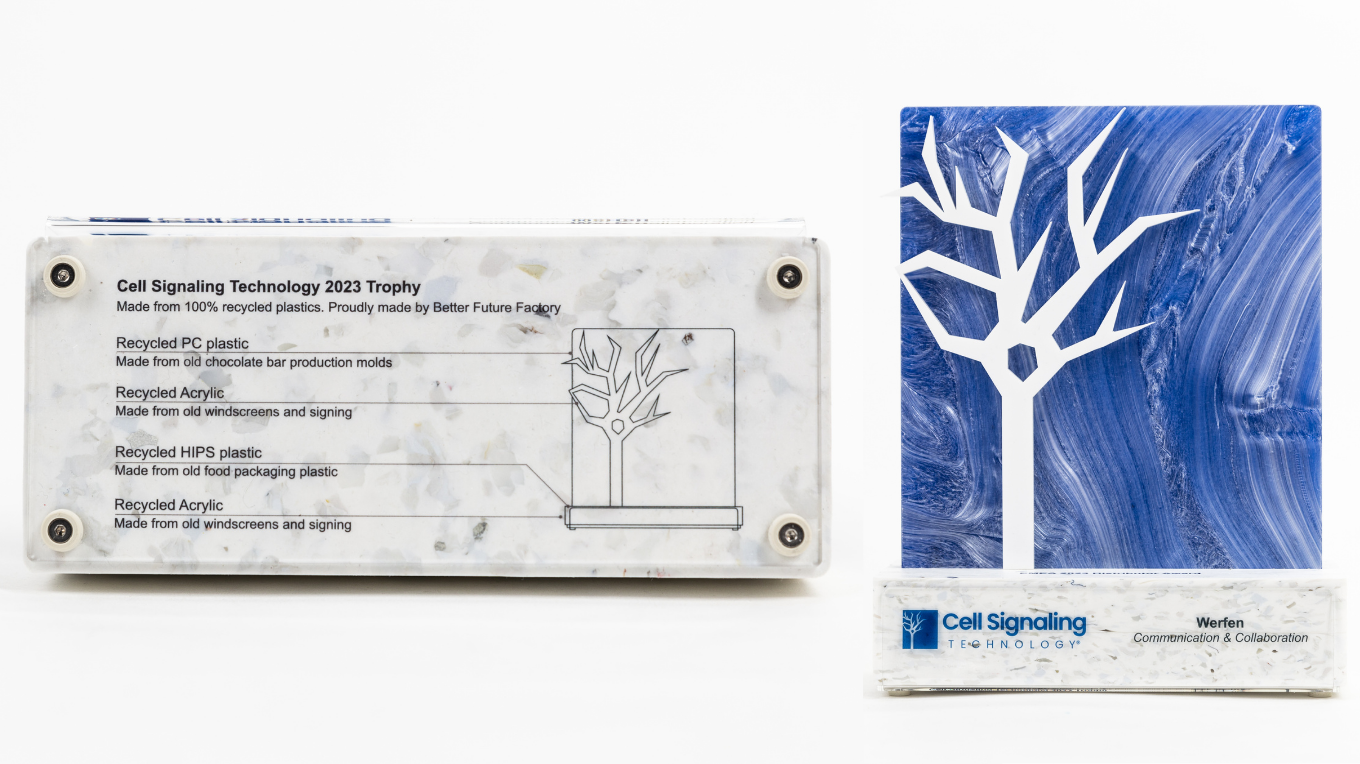
A material passport is a permanent record, built physically into every trophy we make, documenting exactly what the piece is made from, where that material came from, and sometimes the story behind why it was chosen.
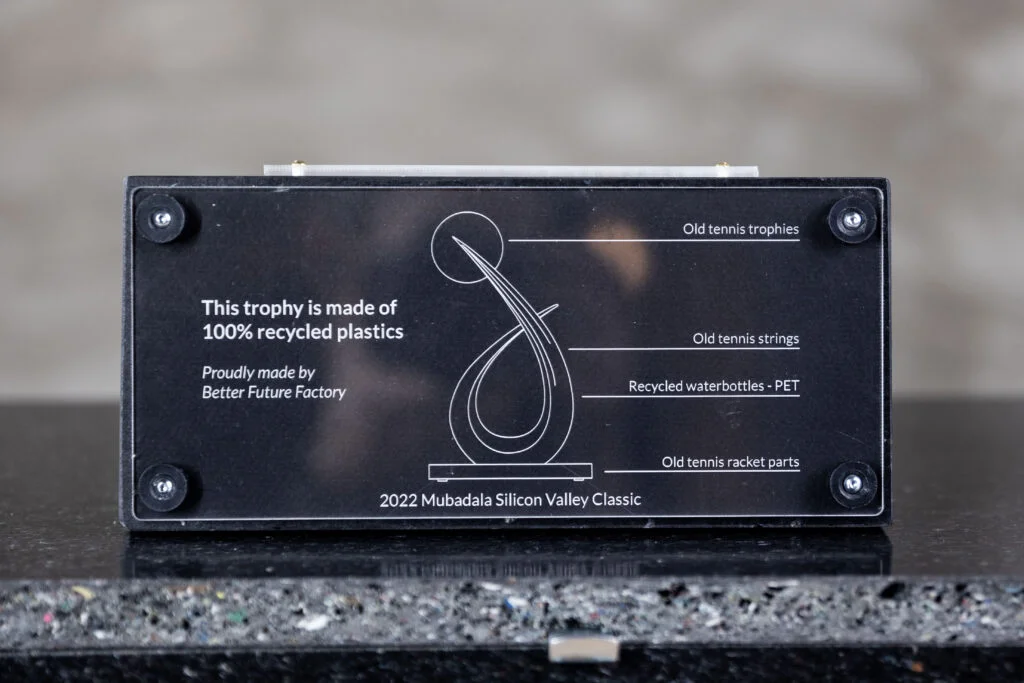
Most sustainability claims in the trophy industry stop at the word “recycled” printed somewhere on an invoice. Nobody checks and nobody verifies it: the trophy gets handed over, the applause happens, and if there was a material story, it quickly gets forgotten along with the trophy itself. We decided a transparency claim on a website wasn’t enough.
We wanted traceability built as a physical part of the object itself, sitting on the base of the trophy where it can’t be lost.
What information does a material passport contain?
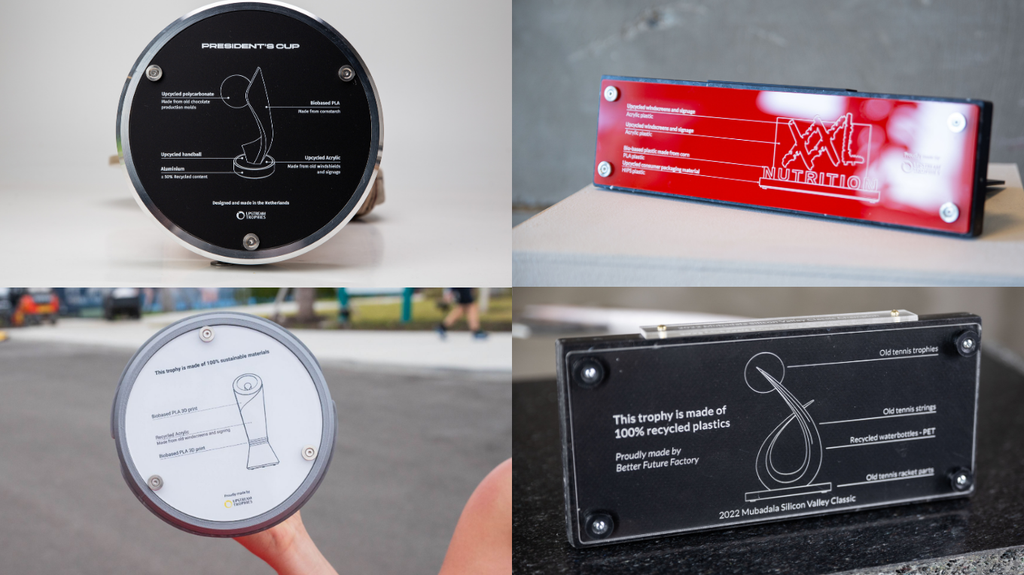
Every Upstream Trophies material passport carries the same core: what the trophy is made from and where the material was sourced.
It’s more than just a list of materials on a webpage or invoice. Our material passport gives insight into not only what the object is made of, but also explains the relationship and story that connects the material and the event.
The KLM trophy we created carries the story of the bottle caps and PET bottles that became it. Our Havenkanjer trophy carries the story of a Rotterdam shipwreck dredged from the port of Rotterdam. The passport isn’t a separate document to keep filed away; it’s a plaque that stands proudly on the base of the trophy for everyone to see.
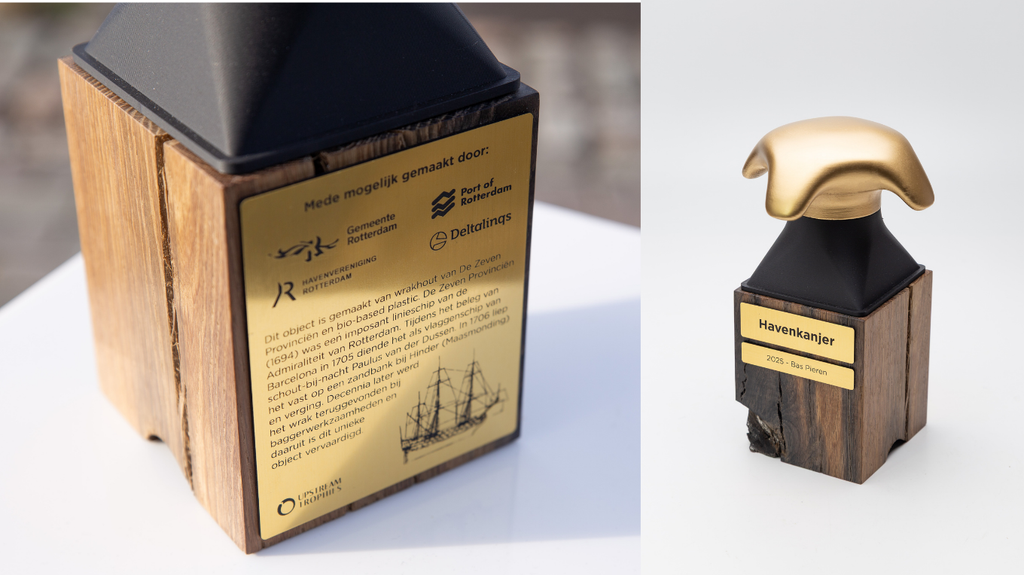
These product passports also serve as a signpost to the next steps – a QR code or web address pointing to whatever a business wants to say next. Whether that’s to promote sustainability goals of a business or it leads directly to a landing page, the material passport on the base of our trophies continues to benefit businesses long after the event is over.
How does a material passport benefit different industries?
We build trophies for very different rooms: boardrooms, sports halls, tech conferences, gallery openings. The material passport can present different benefits for each event and each industry alike.
What does a material passport mean for tech companies?
Tech companies live and die by credibility around claims, and that doesn’t stop when it comes to sustainability. They are among the most meticulous clients we work with.
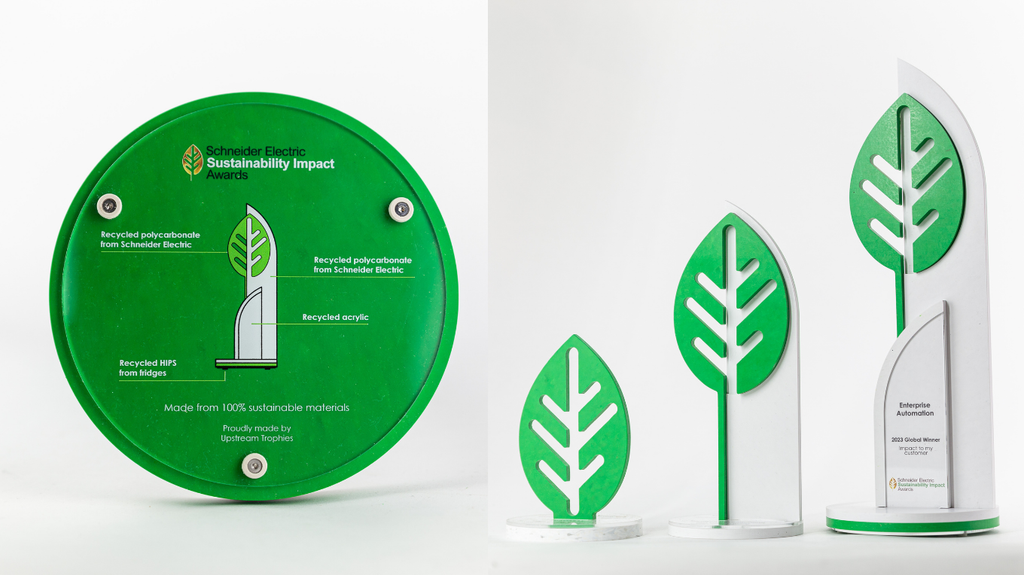
Our work for Schneider Electric has been heavily led by their stringent commitment to sustainability and transparency. So as to align with their circular business model, they commissioned a trophy made entirely from their own waste materials.
But our trophies don’t always have to be made from relevant waste materials.
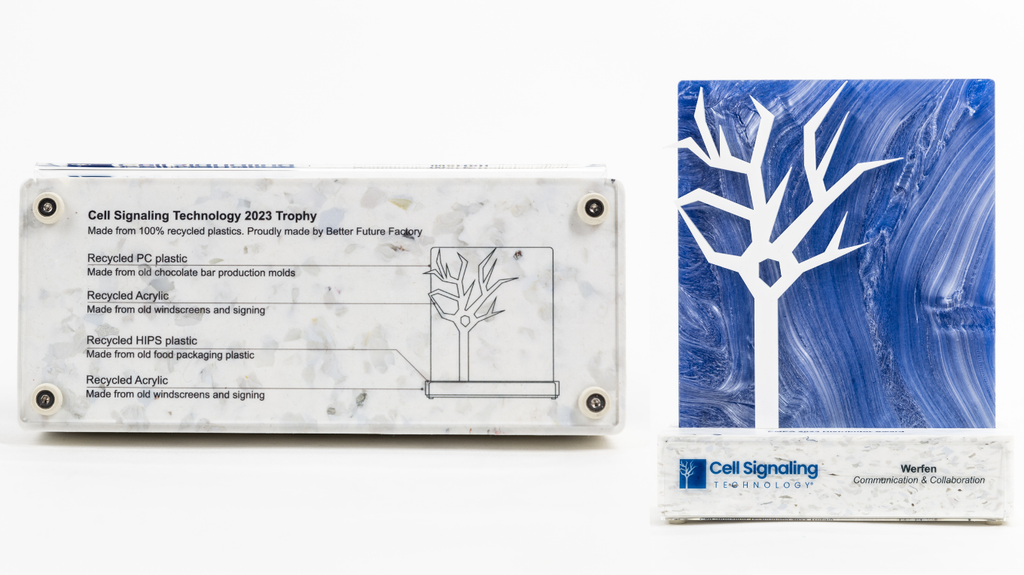
When we built the Cell Signalling Technology award, the brief leaned into the brand’s own logo, using a blue pearl material made from recycled chocolate molds against a base of recycled food packaging. The material passport meant the science of where that material came from didn’t need explaining twice at every internal meeting. It was already written into the object.
With tech companies under constant scrutiny for their environmental impact, having a material passport on your trophy confirms to award recipients, consumers and investors alike that a business is taking their responsibilities seriously. It goes beyond claiming a clean, circular image and actually provides a roadmap of what materials have been reused and what waste has been salvaged from landfill to create the award.
What does a material passport mean for arts awards?
Arts awards carry a different kind of weight. They’re often marking a body of work, a career, or a moment that means more to the room than a single achievement does, and the object handed over rarely has space to say any of that. In fact, how often do we see renowned performers and artists being rushed off stage by the event producers when only halfway through a speech?
A material passport gives that little bit more space to say what needs to be said. Beyond documenting what the piece is made from, the same physical feature can carry a QR code linking through to a fuller story: the recipient’s history with the medium, the heritage of an institution, a tribute to someone the award is given in memory of, a body of work being celebrated.
The trophy fits the size specification. The material passport can be limitless.
What does a material passport mean for sports trophies?
Sport runs on a peculiar contradiction: the moment matters enormously, and the object marking it is usually forgotten within a year – especially when that award is the same tired silhouette.
We made the trophy for the Mubadala Silicon Valley Classic from recycled tennis rackets, and we’ve built awards from potato waste for Ajax. A material passport doesn’t stop a trophy from ending up on a shelf. It does mean that if someone picks it up in ten years and wonders what its story is, the answer is right there.
What does a material passport mean for corporate sustainability claims?
Corporate sustainability claims are under the spotlight more often than most and need substantiation in order to escape the ‘greenwashing trap’.
Transparency and the forward offering of information are what takes a brand from generic eco-friendly jargon to real trailblazers in the world of sustainable corporations.
This is where the material passport can have a significant impact – by providing specific information for all to see, and positioning it as a feature as opposed to a box-ticking exercise.
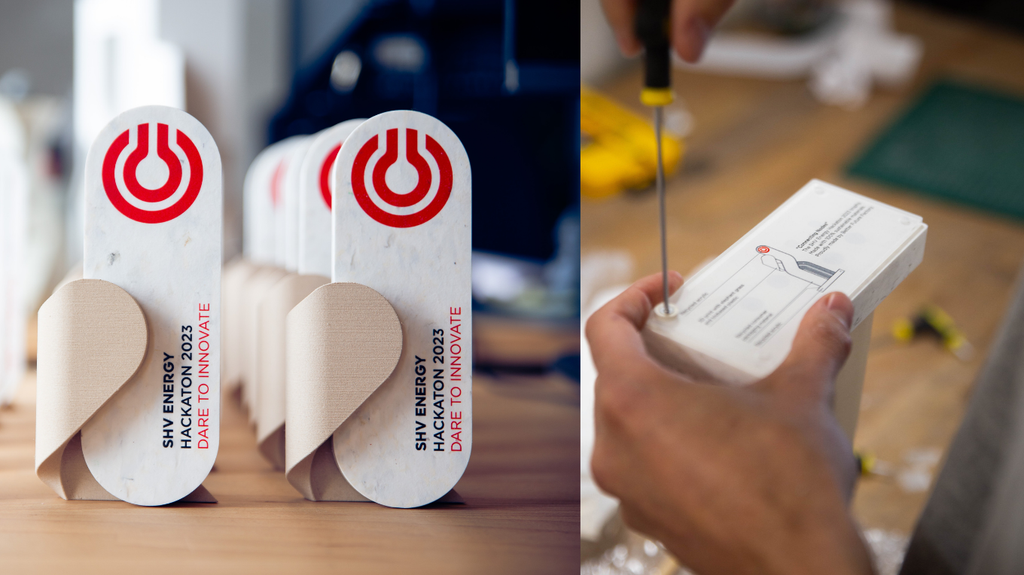
Kerecis’ Awards were made from recycled fishnet and single-use packaging. SHV Energy’s hackathon trophies came from old packaging and elephant grass. When a procurement team or a journalist asks a company to explain what this “sustainable award” actually means, our material passport built into the object is a far more reliable answer than a supplier’s word.
Is a material passport the same as the EU’s Digital Product Passport?
No, but it shares the same spirit. The Digital Product Passport (DPP), recently introduced under EU law, and our material passport are both built on the same intention: traceability and accountability, so a business is in control of the materials it uses and how it uses them.
With this new law, certain product categories placed on the EU market will need to carry a structured digital record of material composition and lifecycle data, accessed through a scannable code, as the European Commission’s own Digital Product Passport page sets out.
Ours isn’t that. Trophies sit nowhere on the EU list. The first mandatory passport lands on batteries in 2027, under the EU Battery Regulation. Under the Ecodesign for Sustainable Products Regulation, groups like iron and steel, textiles, furniture and electronics follow one at a time, each through its own delegated act. Nobody is going to ask us for a passport on an award any time soon.
We build one anyway. It’s voluntary, it’s physical, and it sits on the base of the trophy instead of behind a scan. The principle is the same as the Digital Product Passport: prove what something is made from rather than claim it. The difference is that we started before anyone asked.
Why did we build the material passport this way?
We could have put the material story in a leaflet, or a certificate, or a page on our website that nobody revisits after the ceremony. We built it into the base instead. By pairing the story with the physical object, it cements the fact rather than leaving it open to interpretation.
Every custom trophy we make carries one. Every material we use, whether it’s reclaimed oak, recycled fishing nets, or old aeroplane parts, has a backstory worth more than a footnote, and our material passport is where that backstory lives.
Want to find out about the power or bespoke trophies and awards? Read here.
Explore custom-made trophies from Upstream Trophies.
FAQ
What is a material passport?
A material passport is a permanent record, built into a physical object, documenting what it’s made from, where the material came from. Sometimes it also includes additional information such as the story behind the material.
Is a material passport the same as a digital product passport?
No. A Digital Product Passport (DPP) is a specific EU legal requirement for certain product categories. Upstream Trophies’ material passport is a voluntary practice for complete transparency, built physically into the trophy rather than accessed digitally.
Does a material passport prove the material is really recycled?
It names exactly what the piece is made from and where that material came from, down to specific stories like a shipwreck salvaged during dredging or a client’s own waste stream. That’s more checkable than a general “recycled” claim on an invoice.
Can the material passport link to more information, like a QR code?
Yes. Alongside the physical description, many of our material passports include a QR code or web address that links to further information, such as a business’s sustainability goals or a dedicated landing page.
Why does the material passport matter for corporate awards?
It gives companies a physical, checkable answer when their sustainability claims are questioned, rather than relying on a supplier’s word alone.
Is the material story documented physically or digitally?
Physically. It’s built into a plaque on the base of the trophy itself, rather than stored in a separate leaflet, certificate, or web page.