







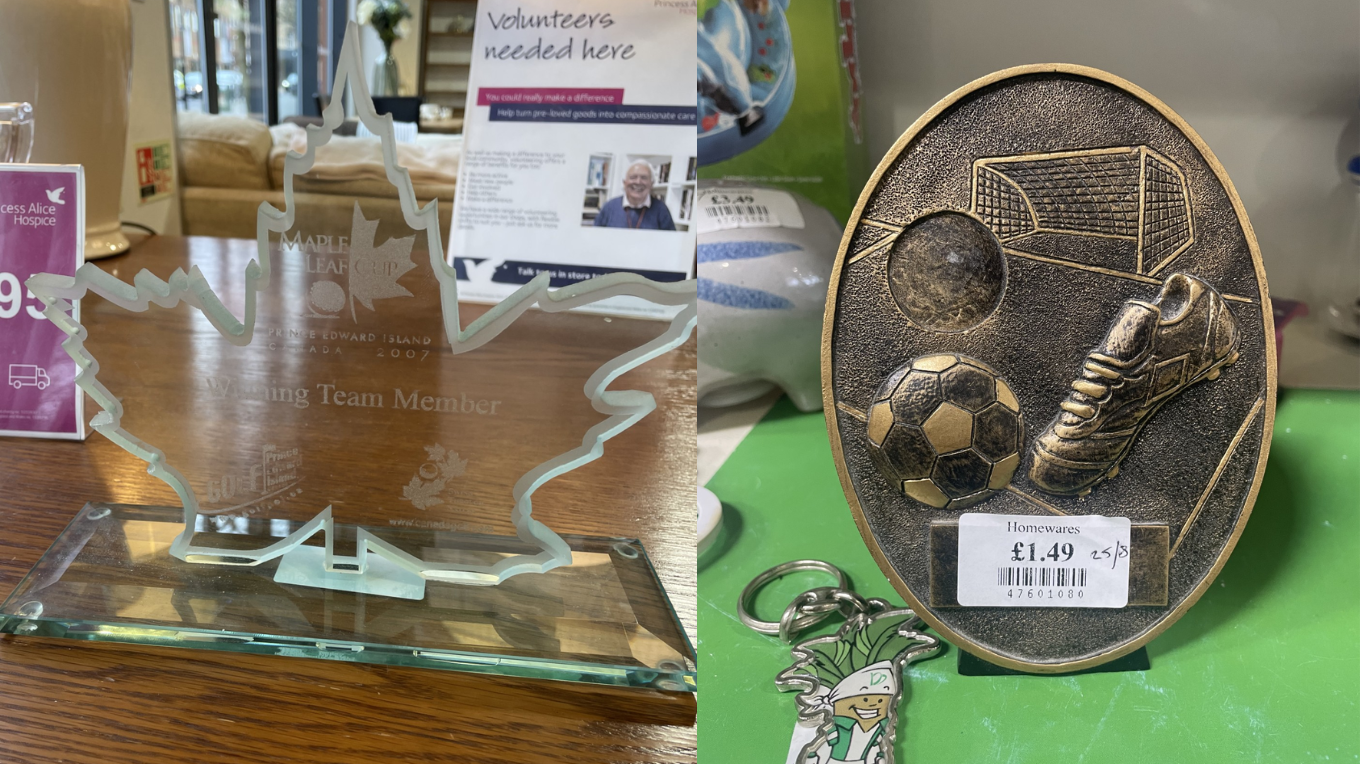
Finding trophies on the shelves of thrift stores always feels strange. Like something has gone wrong.
These are once meaningful objects. Personalised. Engraved. Created to mark a specific achievement for a specific person. And yet they end up discarded – stripped of context, reduced to an anonymous object on a shelf between someone’s old paperbacks and a broken toaster.
Understanding what makes a trophy meaningful and why so many fail to hold that meaning over time starts here. With the donation pile.
Why awards lose their meaning
Awards, at their best, exist to recognise effort and mark a moment. To give something physical to an otherwise intangible achievement. A good award becomes a reminder – not just of what was done, but of how it felt to be recognised. It captures a moment in time and gives it permanence.
It’s easy to romanticise that, especially when you’re looking at something engraved and discarded. To imagine a story where the meaning was lost over time, where life moved on and the trophy couldn’t keep up.
But the reality is often simpler, and far less flattering.
Not every award is built on genuine recognition. Many exist within a system where visibility, sponsorship, and participation carry more weight than the achievement itself. Industry awards with paid entries, sponsor-led categories, tables bought alongside trophies – these aren’t hidden mechanics. They’re widely understood.
And yet companies still take part. Because the value isn’t always in the award itself. It’s in what comes after. A badge on a website. A line in a press release. A reason to communicate success.
The trophy becomes proof, even when the meaning behind it is thin.
When that happens, the object loses its weight. Not physically, but symbolically. A heavy piece of glass or metal can still feel insignificant if there’s nothing behind it. And once that meaning fades, it’s no surprise that it ends up forgotten.
Where most trophies fall short
This is where most trophies fail. Not in craftsmanship, but in intent.
A trophy only holds meaning if the recognition behind it is real and if the object is designed to carry that meaning forward. That might mean materials that relate to the event itself, a shape that comes from somewhere rather than from a catalogue, or a story embedded into the object rather than added as an afterthought.
What makes a trophy meaningful, in most cases, is exactly that: intentional design that matches the significance of what’s being recognised.
Generic trophies signal that the recognition was a process, not a decision. A standard shape, a logo applied to the front, a name engraved. The recipient can tell. Their colleagues can tell. Everyone involved usually can.
How bespoke trophy design changes things
This is where custom-designed event trophies start to shift things.
When a trophy is designed specifically for an event, a person, or a moment, it carries a different kind of weight. Not just because it looks different, but because it means something. The design process itself becomes part of the recognition: a deliberate act of creating something that matches the significance of the achievement.
At Upstream Trophies, this is the starting point for every event trophy we make. Every award begins with a story: what is being recognised, who it’s for, and what the object needs to communicate. Material, shape, and structure are all built around that narrative, not the other way around.

It’s the intention behind the design that strengthens the bond between the recipient and the award.
A generic trophy can be appreciated. A bespoke one evokes something different. That emotional connection is what maintains meaning over time – and is what keeps a trophy off the donation pile.
The role of materials in meaningful trophy design
When materials are chosen with intent – recycled plastics from a relevant industry, reclaimed elements tied to the event, or a form that reflects the nature of the achievement – that’s when the award becomes a continuation of the story that led to it.
A material with a past gives the object a narrative that a new, generic material simply can’t. That’s the difference between a trophy that gets displayed and one that gets stored.
At Upstream, our approach is built around material storytelling. Using recycled and reclaimed materials serves more than one purpose. Yes, they reduce environmental impact. But they also add context, depth, and a reason to talk about the object long after the night it was handed out.
That connection between the material, the design, and the story is what makes people keep trophies. It’s what makes people display them, and it’s what keeps them talking about them.
A shift is happening
There are still many organisations operating within the old model. Producing awards that look the part but don’t carry the substance. Objects designed to signal success externally rather than to create a meaningful internal moment. In those cases, the lifecycle of the trophy is predictably short.
But the direction of travel is changing.
More organisations are moving away from “this is how it’s always been done” and towards something more deliberate. Treating employee recognition and event awards as designed objects with purpose rather than just self-serving promotion. Sustainability is a big part of that. Creating disposable awards feels increasingly out of step with the expectations placed on organisations around environmental responsibility.
A trophy designed to be forgotten contradicts the very idea of longevity. Circular thinking, material choice, and considered design are becoming part of the brief because they add depth that a generic award never could.
When the material, the design, and the story are aligned with the achievement, a trophy becomes harder to discard. It holds its place. It stays visible. It keeps the conversation going long after the moment of recognition has passed.
That’s what makes a trophy meaningful. And it’s why the ones that end up in thrift stores almost always started without a story worth telling.