







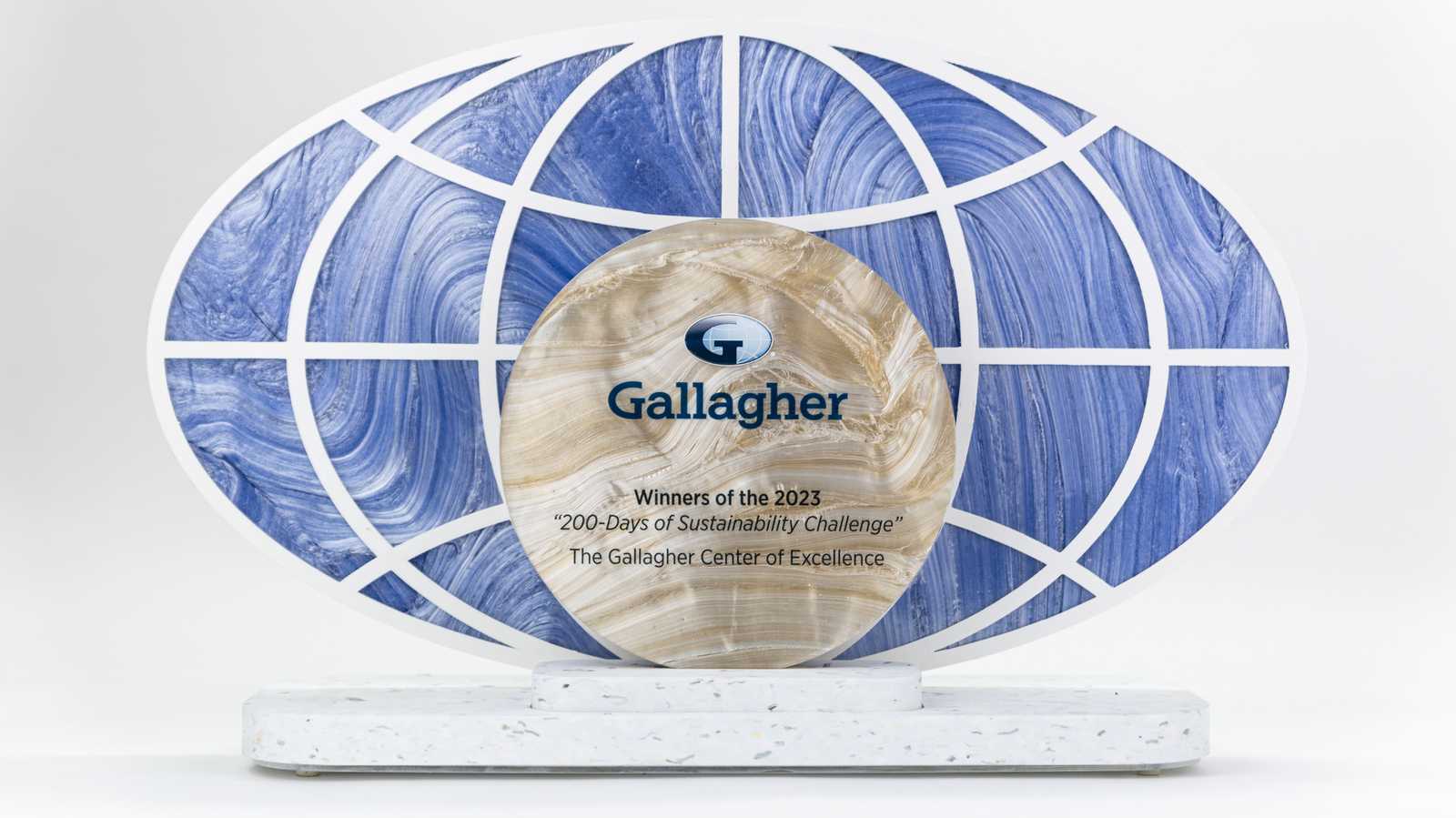
More than just an object handed out at the end of a ceremony, an event trophy is a symbol of everything the event wants to communicate: achievement, identity, dedication, values, quality and sponsorship.
For engraved event trophies with logo branding and personalisation, it’s a delicate balance between getting the logo seen and not allowing it to overpower the award. It needs to be visible, yet not dominating.
Personalisation is another variable to consider. The personalised engraving needs to be strong enough to be seen under harsh stage lighting, and it must be intentional and not just templated.
Engraved event trophies with personalisation and branding are all about this balance. When custom event trophies are done well, they are able to communicate both recognition and commercial value without compromising either.
Why logo branding matters on event trophies
Often treated as a decoration option, logos on event trophies actually hold far more purpose. The logo will carry out a purpose long after the event ends.
For sponsors, this visibility continues the lifecycle of their investment. Unlike digital ads, event-day placements or print ads, trophies often end up on shelves, desks, in display cabinets, and remain physically present and on display in offices, reception areas or other high-traffic places due to the ‘bragging rights’ awards afford. The branded logo on the surface becomes a permanent opportunity for in-person impressions.
It’s a version of the same effect PPAI’s consumer research has tracked for years: branding on physical items that stay in someone’s daily environment gets remembered at a rate most advertising can’t touch. A trophy just has more permanence than most items on that list.
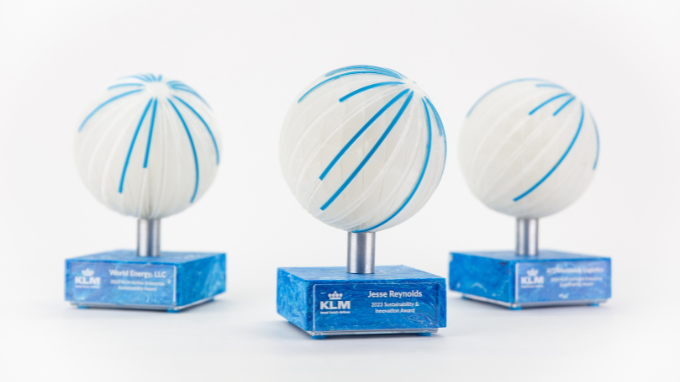
But the same applies to the awarding brand itself – the tournament, sporting committee, awarding body, or regulatory association that is presenting the award also has an opportunity for seemingly endless advertising.
However, effectiveness depends on the hierarchy between the two brands (if the award is sponsored), and the receiver of the award. The winner, in all instances, should always be the focal point. The logos need to work in unison with each other to support the composition of the trophy rather than compete for attention.
When brands and trophy designers get this wrong, it often looks like:
- Oversized logos that reduce perceived prestige
- Multiple brands competing for space, creating too much visual noise
- Artwork that is out of proportion and weakens the finish quality
- Lack of contrast between the engraving and the material
- Materials interfering with the print
Premium event trophies rely on restraint and positioning. The goal is visibility and longevity, not size of the logo.
Engraving options for engraved event trophies
The method of engraving can vary and is mostly a matter of personal preference. Most trophy manufacturers will offer a default engraving method and not options, so if you already have ideas for your event trophy, communicate it with your trophy designer early on in the process.
Here are a few different material engraving methods for event trophies:
Laser engraving
This is the most common method for modern engraved event trophies. It produces sharp, consistent results across materials such as acrylic, wood, metal, and recycled composites.
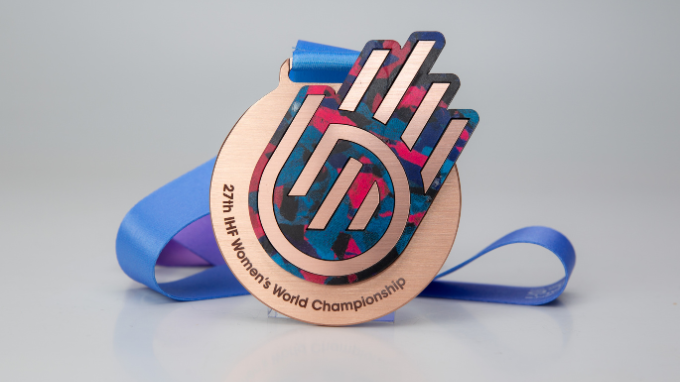
Its popularity is likely because of its precision, making it particularly suitable for corporate or multi-category events where consistency is needed across a large number of awards.
Etching
This is most widely used for glass and crystal, because of its softer, light-responsive finish.
Colour printing and hybrid branding
Where event trophy or sponsorship branding needs full colour logos, UV printing is often used. It allows reproduction of gradients, brand palettes and detailed artwork.
Adding colour is, however, a delicate balance. Overuse can shift the perspective from premium to promotional. The last thing you want your trophy looking like is another free giveaway. This is why maintaining the focal point on the winner is so important.
The strongest results typically combine subtle engraving with controlled colour placement on the finished trophy.
We know that engraving is a delicate balance, and that each trophy can have different considerations, such as colour flecks and slight variations. For that reason, we take extreme care ensuring that each instance of engraving is overseen and quality-checked.
We offer UV printing directly onto plastic or metal, allowing the engraving to hold full colour. An example of this can be seen in the award we created for the SHV hackathon project (see below).
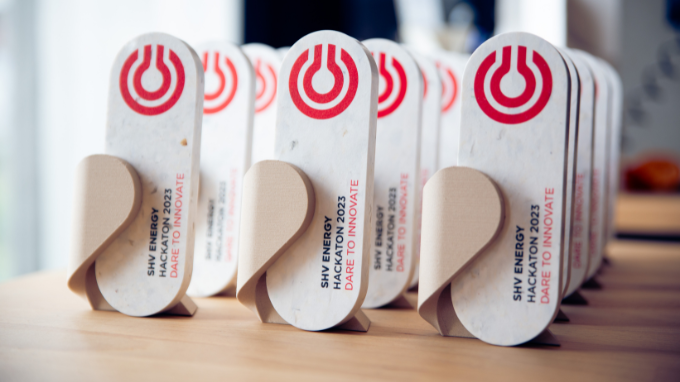
We also offer laser engraving – on our engraving sheets, a white base sits beneath a black top layer, and we etch that top layer away with the laser to produce sharp, high-contrast detail; and on stainless steel, we can manipulate the colour. On wood, the laser darkens the surface wherever it passes.
When we engrave in acrylic, instead of adding colour we carve genuine depth into the material and fill it with chalk, the most sustainable option we offer, though it’s limited to a single colour.
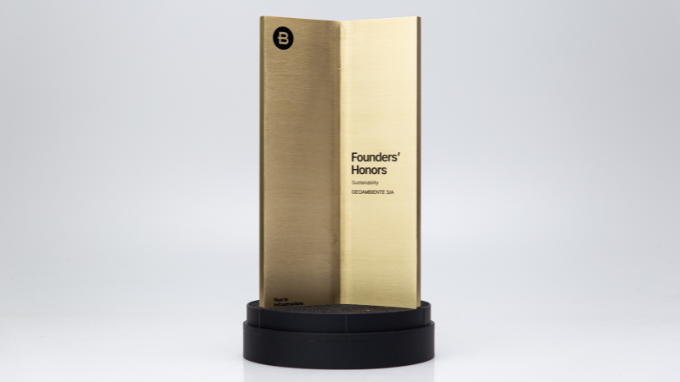
In our Bentley project (pictured above), we created a very premium engraving into metal where the engraved trenches were filled with ink, creating a deluxe and exclusive finish.
Adding logos and sponsor branding to event trophies
When it comes to integrating logos into personalised event trophies, it’s often composition over placement.
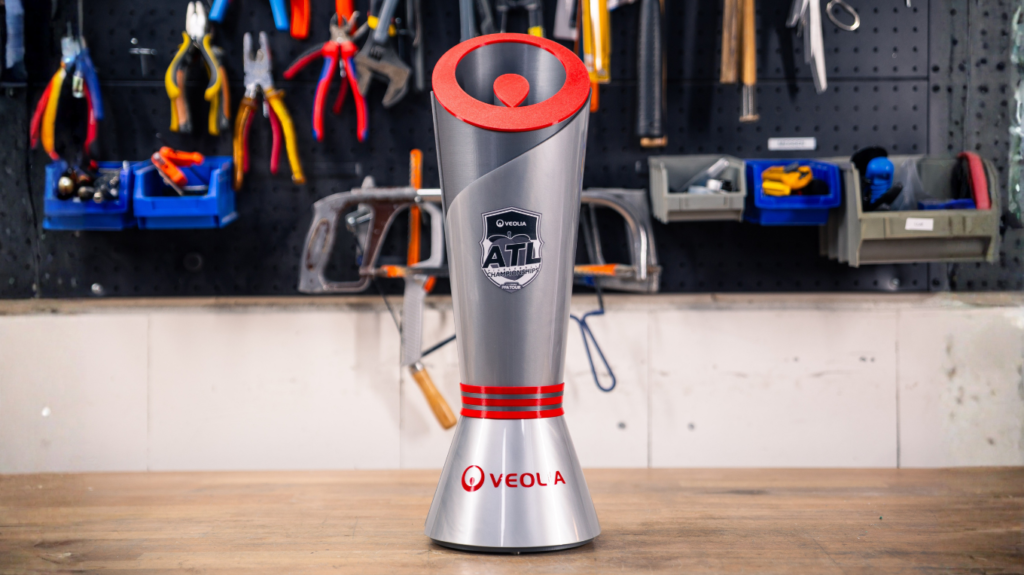
The key is deciding (or knowing) what the hierarchy of visual information should be. Most event trophies have at least three competing elements:
- Event identity – this should be first position in order to maintain the award’s prestige and the meaning to the audience.
- Winner recognition – extremely important, and should be the focal point of any text that appears on the trophy.
- Sponsor branding – important but needs to be subtle.
Only one of these should lead visually at close reading range.
Effective integration follows several design principles:
- Maintain clear spacing around all logos.
- Avoid compressing typography into limited surface areas.
- Use consistent alignment across the trophy range.
- Ensure artwork is optimised for engraving resolution.
- Match branding technique to material behaviour.
When reclaimed materials are used, this requirement is amplified. Variations in surface texture mean that design needs to be intentional and well thought through to achieve maximum consistency across a series of event awards.
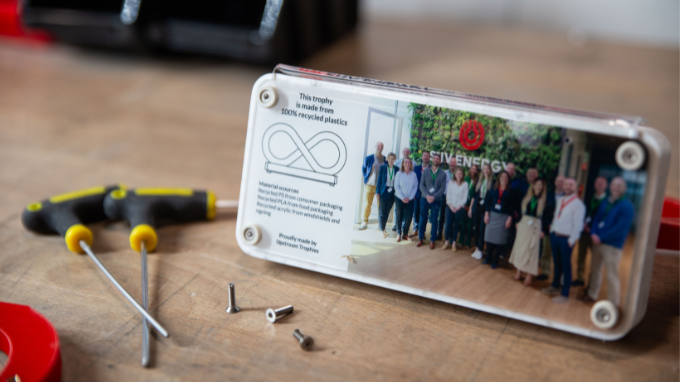
The objective is an overall controlled presence – visible, but not overpowering. Our material passport feature provides just that, with hidden additional space allowing for a cleaner overall design, while still providing key information. Not only is this a space to provide an overview of material transparency, but it can also be a space to display additional brand-focused text and even a QR code leading to further information.
Best practices for premium engraving on trophies
Premium engraved event trophies rely on decisions that are often invisible when first searching for an award.
For instance, when engraving our trophies, we’ve worked hard behind the scenes to ensure the printing holds on the surface – something that can be tricky with plastic materials, as some of them tend to behave as if they were oily. We’ve worked on different methods and have perfected techniques to make sure the printing stays put.
Here are some other best practice methods:
Typography is the most overlooked factor. Highly decorative fonts tend to degrade readability under engraving, making it difficult to pay tribute and recognise effectively. Clean, structured typefaces consistently perform better on a range of materials and can be clearly read under a range of lighting.
Spacing is equally important. Overfilled layouts reduce clarity and weaken hierarchy. Even when multiple sponsors are present, whitespace is what preserves perceived value and allows any shift in surface texture to go unnoticed.
Material compatibility also plays a defining role. Some surfaces produce high-contrast engraving with sharp definition, while others naturally diffuse detail into softer finishes. Designing with material behaviour in mind ensures the final trophy feels fully thought through, rather than adapted at the last stage.
Timing also affects outcome quality. Logo approval, proofing, and engraving setup introduce production stages that require accuracy and time. Rushed approvals increase the risk of misalignment, inconsistent branding, or rework – all of which impact both sustainability and delivery efficiency.
The strongest trophies are rarely the busiest ones, or those with the most complex designs. They are usually minimal, full of ‘white space’ and allow the winner to focus on the overall award composition rather than the sponsor or event logos
Have an idea you want to discuss further? Get in touch.
FAQs about engraved event trophies with logo branding
Can event trophies include logos?
Yes. Most engraved event trophies with logo integration can include event branding, sponsor logos, and partner identities using engraving, etching, or print methods depending on material choice.
What engraving options are available for event trophies?
Common options include laser engraving for precision, etching for premium glass finishes, and UV printing for full-colour branding. Each method produces a distinct visual and tactile result.
How do you add sponsor branding to trophies?
Sponsor branding is typically integrated through controlled logo placement within the trophy layout. The most effective approach ensures sponsor visibility without competing with winner recognition.
Does engraving affect delivery time?
Yes. Personalisation introduces additional production steps, including artwork approval and engraving setup. Lead times may increase slightly depending on order size and complexity of branding requirements.
What engraving techniques does Upstream Trophies offer?
We offer UV printing directly onto plastic or metal for full-colour engraved branding, laser engraving on our engraving sheets or directly onto metal and wood, and engraving into acrylic. Each technique produces a different engraved finish depending on the material, from high-contrast results on our black-and-white engraving sheets to colour-steered engraving on stainless steel, so the right method depends on the finish the trophy calls for.
How can I maximise the engraving space on an award?
Our material passport space can also be used to hold additional engraved brand text or a QR code alongside the material information, giving branding room to sit clearly without crowding the winner’s own engraved recognition.
Does the type of plastic affect how well engraving holds?
It can. Plastic can behave as if oily on the surface, which makes engraved printing harder to hold cleanly. We’ve developed specific methods to counter this, so engraving stays put regardless of the plastic type used.