







The Venus Rosewater dish is probably one of the most understated trophies in sporting history. Surprising, really, considering it’s the award for the world’s most prestigious tennis event.
When you take a closer look at the intricate design, it begs the question: Why isn’t this trophy more famous?
A trophy unlike any other
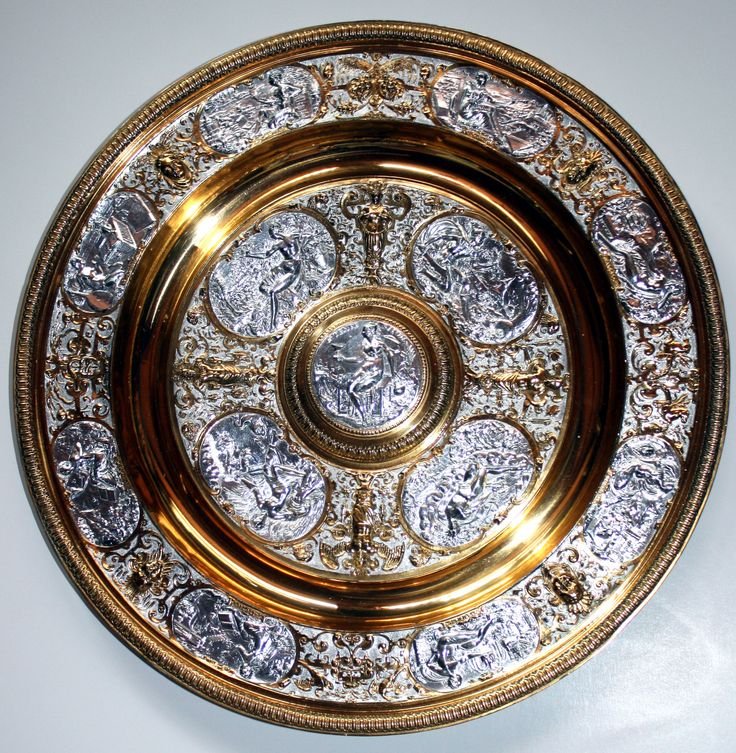
The Venus Rosewater Dish has been awarded to the Wimbledon women’s singles champion since 1886. It’s a partly gilded sterling silver serving dish. Not a cup. Not a plate in the conventional sense. Something closer to a ceremonial basin, the kind of object you’d expect to find in a museum rather than being handed to someone who’s just played five sets of hardcore sports in the July heat.
At the centre is a figure of Temperance, seated on a chest with a lamp in her right hand and a jug in her left. Around her are the four classical elements: earth, water, air, fire. Along the rim, representations of the seven liberal arts: grammar, rhetoric, logic, geometry, arithmetic, music, astronomy, all overseen by the goddess Minerva.
Every element of the surface means something. The object was designed with an internal logic, a symbolic programme. There are no decorative choices made for the sake of filling space.
The copy that became the original
What’s interesting is that this isn’t an original design. The Wimbledon trophy is a replica of a 16th-century Renaissance pewter basin originally designed by French pewterer François Briot, a common ceremonial object used as a rosewater dish at formal gatherings. The mould used to make the trophy was taken from a plaster cast of the Louvre’s version of the dish, sold to Birmingham silversmiths Elkington and Co. around 1849.
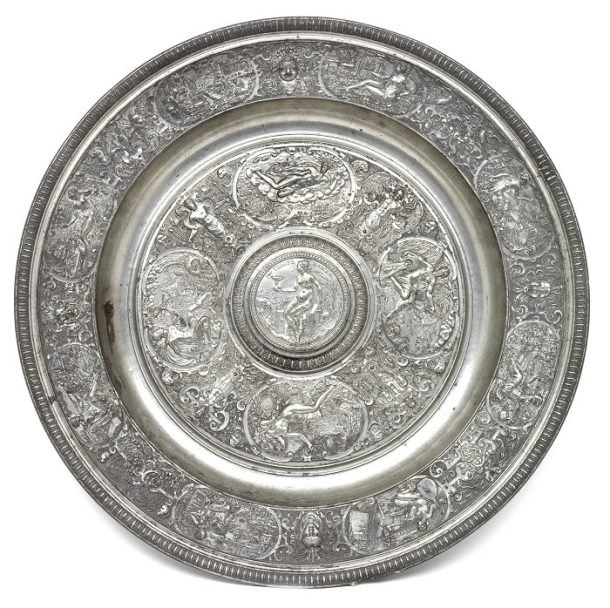
This means the women’s Wimbledon trophy is a copy of a museum piece, which was itself a copy of a 400-year-old pewter basin that had nothing to do with tennis!
We often talk about breakthrough sports or tournaments having a chance to forge a new silhouette. Well, in the 1800s, Wimbledon had that chance. The world of competitive sports wasn’t yet saturated like it is today, and still its creators found an opportunity to create something different to the standard cup. Perhaps it was an attempt to differentiate between the women’s and the men’s tournaments, or maybe it was simply an opportunity to create an etched story of divinity for the highly sought-after award through the symbols engraved on the plate.
Whatever the reason, the All England Club found an existing object with the right weight and presence, and made it theirs. And it worked, completely, to the point where the Rosewater Dish is now more synonymous with Wimbledon than the original is with the Louvre.
How a borrowed object became a symbol of victory
Temperance, the liberal arts, the four elements: none of it has any particular connection to tennis. And yet the object carries meaning, real meaning, because of the journey it’s been on.
The names of every women’s champion since Blanche Bingley in 1886 are engraved on it. The history accrued to the object over 140 years has given the original symbolism a new context entirely.
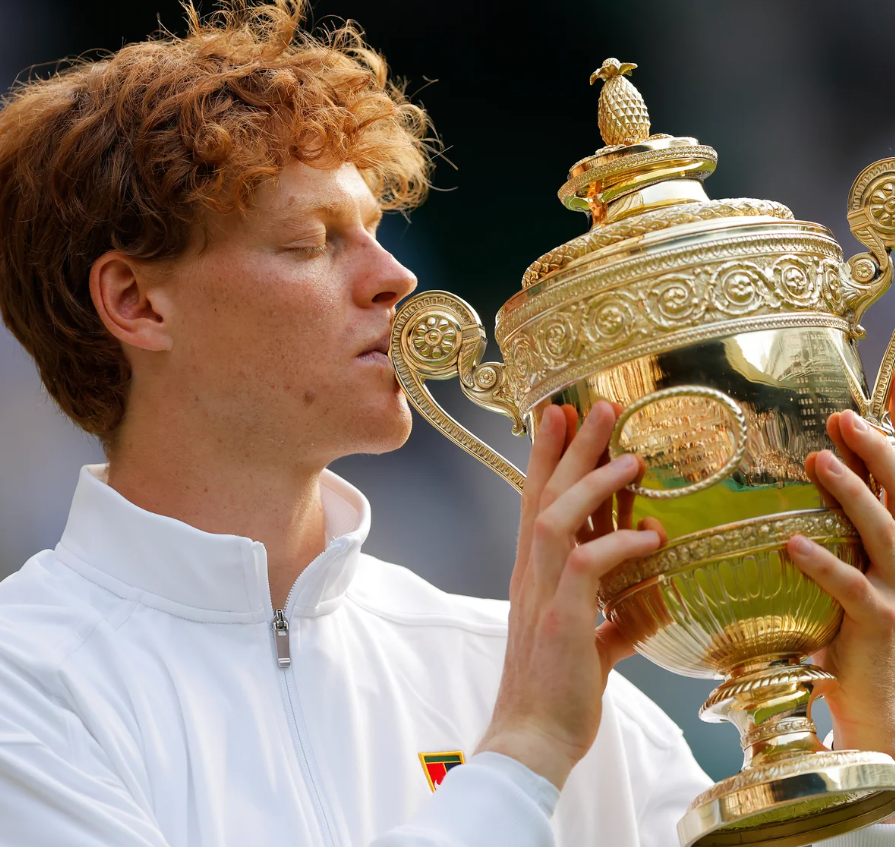
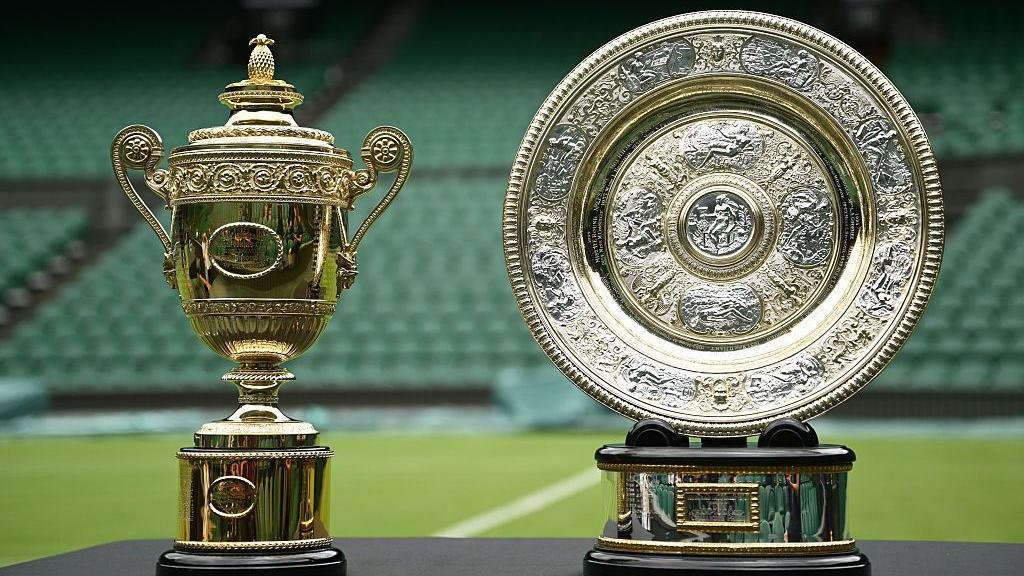
The men’s trophy, by contrast, is a Victorian cup with a pineapple on top. The pineapple was a Victorian status symbol – and, once again, it has no connection to the sport. The cup is handsome in a conventional way. It photographs well. But next to the Rosewater Dish, its form lacks innovation.
The Dish reads as something else: a subjective object. Something that carries a different meaning for different onlookers. Something that inspires more questions than it answers.
The object outlasts the moment
Eleanor Thomas, collections manager at the Wimbledon Lawn Tennis Museum, has noted that the Dish has since transcended its origins as a decorative prize to become a symbol of achievement in its own right. Much like an Oscar, holding the title of Wimbledon Champion carries weight across the globe.
The Venus Rosewater Dish is a symbol of peak career within women’s tennis, the meaning of which has become greater than the Dish itself. But that all started with a design good enough to capture attention and desirable enough to build status – which is where we believe every trophy design should begin.
Not whether it looks expensive, or if it fits the standard trophy silhouette. But whether the object has enough internal logic to mean something beyond the moment it’s handed over. Will someone who picks it up ten years later, with no context, be able to feel the depth of the thought that went into it?
The brief for every trophy we make starts with the same questions: what does this event stand for, who is it for, and what should the object communicate that the trophy itself can’t? The answer shapes everything: the form, the surface, the way it feels when held – a lot of which can be decided through the material used, which in itself can communicate on different levels. We document the origin of every material in a material passport, because the material’s journey is a huge part of the story the object tells.
The Rosewater Dish wasn’t designed for Wimbledon. It arrived with centuries of meaning already embedded in it, and Wimbledon made it theirs. These days, most organisations don’t have that option. The design conversation has to do that work from scratch: building an object with enough of a foundation that the event grows into the award, rather than outgrows it.
Interesting reads, straight to your inbox.
Sign up to our monthly newsletter where we share articles similar to this one, sustainability news and the latest in trophy design. Register here.