Few events in the British film calendar carry the weight of the London Film Festival awards. Hosted by the British Film Institute, this festival celebrates films from all corners of the world and creates a global platform for newly emerging talent – with daily movie premieres and star-studded red carpet interviews.
But even if you follow the festival, you’ll be challenged to think of a particular shape that accompanies the awards.
In fact, over the years winners at the festival’s ceremony have been awarded with vastly different silhouettes. A silver sculpture, a portrait bust, a textured bronze star and a disc of blue glass. Most shocking of all, is that since 2023, winners have gone home with no trophy at all.
When it comes to trophy shillouettes, none has had more impact in the arts than that of the Oscars: the gold statuette – a figure presented since 1929.
While both Oscars and the London Film Festival awards are steeped in years of tradition, there’s a lot to be said about the heavy-lifting a physical award does when it comes to brand identity.
The Sutherland silver
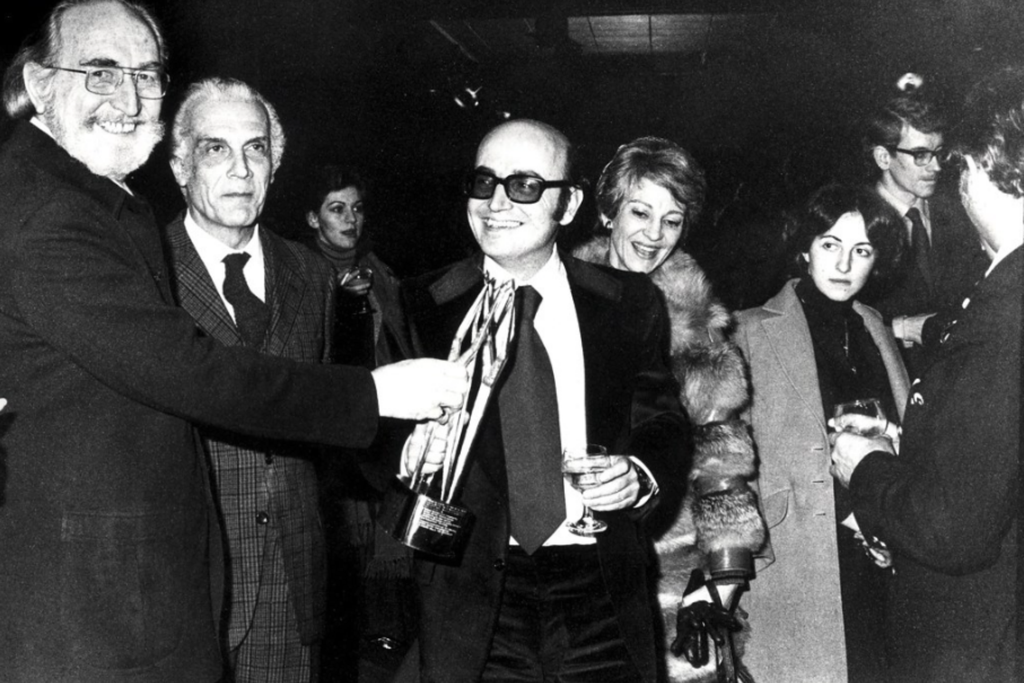
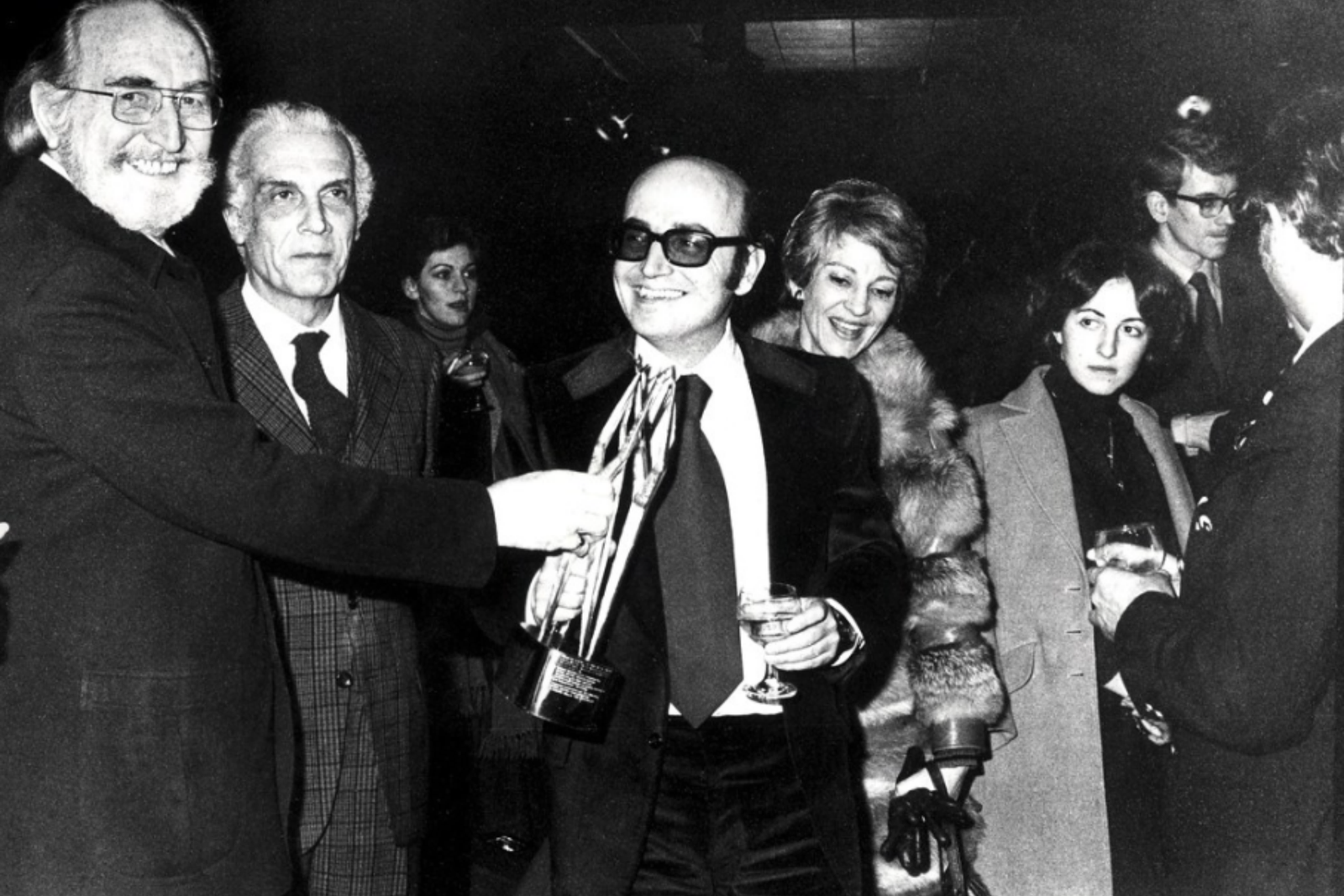
The London Film Festival awards were first presented in 1958. The Sutherland Trophy, named after the 5th Duke of Sutherland – patron of the BFI, was crafted by the silversmith Gerald Benney. It featured a tree-like shape with branches of silver reaching into the air. The Sutherland Award has a winner each year, but is never actually given out for more than a few hours – living permanently at the British Film Institute in London.
It was first won by Yasujirō Ozu for Tokyo Story, and over the following decades it went to names such as Satyajit Ray, Michelangelo Antonioni, Jean-Luc Godard and Bernardo Bertolucci.
The Grierson Award
The Grierson Award for documentary took a more literal approach in its shape. The London Film Festival awards ran its Grierson Award in association with the Grierson Trust. The prize was a bust of Grierson himself, sculpted by Ivor Roberts-Jones. Cast as a limited edition, initially only 10 versions were created with the intention of the awards travelling to the next prize winners. The award model has now been changed, and each winner gets to take home the permanent piece.

The Star of London
The awards had a shake-up in 2009 when it came to trophy design and Almuth Tebbenhoff created a sculpture named The Star of London.

From this point until after 2022, The Star of London was permanently awarded to winners in across several categories – including the Sutherland Trophy winner.
A quick search of the London Film Festival awards suggests that this is the closest the ceremony ever got to having an identifiable silhouette for its winners. Photographs from the ceremonies show a rounded, textured form with a star worked into its face.

A star on a column
By 2018 the Best Film winner was photographed holding something different: a bronze star mounted on a slim column, with a nameplate at the base.
It’s unconfirmed what the name of this award is for, – but it’s unlikely it was brought as an accessory to the carpet.

The Fellowship glass
The BFI Fellowship, the BFI’s own honour, has also been presented at the festival’s awards ceremonies.

In 2009, John Hurt took this home for his contribution to acting, and also renowned Malian film-maker Souleymane Cissé.
Cate Blanchett was awarded the Fellowship in 2015 and Steve McQueen in 2016. Each received the blue glass object – its contemporary design looking a long way off from the Star of London, and closer to a lens than a statuette.
Other notable recipients of the fellowship award include Tom Cruise, Helena Bonham-Carter and Spike Lee.
After 2022
The BFI retired the physical award after the 2022 festival, and no physical award has been permanently presented since. The competitions will continue well into the future, with this year’s winners announced on 18 October.
Some of the variety of awards listed above have a straightforward explanation. The awards came from different places: The Grierson bust belonged to a separate trust, and the Fellowship sits outside the festival’s competitions altogether.
Each award brought its own object with it, and steered clear of similar design. While this may have been intentional, awards that are part of the same family often do more for a brand or event if they are designed as such.
What the Oscar has that the LFF doesn’t
The Oscar was sketched by the MGM art director Cedric Gibbons and sculpted by George Stanley in 1928. According to the Academy, the design has never changed from its original conception. Only the base varied in size, until a standard was fixed in 1945. Its official name is the Academy Award of Merit, but the nickname stuck so firmly that the Academy formally adopted it in 1939. The statuette is now a registered trademark of the Academy and a firm identifier of the Oscar brand itself.
The Academy’s size and Hollywood’s reach put the Oscar in front of a global audience every year. The unchanging figure made sure that audience saw the same thing every time.
Over nine decades the object has become shorthand for the institution.
Neither half would have produced the same result alone. The LFF has the institution: the BFI, a 70-year history and a festival held in London every October. But it has never kept one object long enough for the shape to become shorthand.
When sifting through images, a photograph of an LFF winner relies on the branded backdrop behind them to tell you what they won, because the award in their hands could be any of five shapes – or nothing at all.
Smaller ceremonies don’t have the backdrop
While we can argue that the London Film Festival awards are missing a trick, the BFI can carry this quirky approach to its trophies because its name holds the recognition. Most awards ceremonies don’t have that luxury.
A regional film festival, an up-and-coming talent show, or an art competition still establishing its foundation has no global audience to fall back on.
The trophy is often the only part of the evening that travels beyond the room. It sits in an office reception, appears in a winner’s social media post cropped down to their hands, and stays on a shelf for decades after the ceremony.
If the award changes shape every few years, each new design starts building recognition from nothing. A consistent design lets every year’s winners add to the same picture.
For organisers commissioning an award they want to last, a few points belong in the brief:
- A silhouette that reads clearly at the size of a phone photo, without a backdrop to explain it.
- One form that can cover several categories through the base, plaque or finish rather than a different shape for each.
- A material and maker the organisation can return to year after year, so a replacement or an anniversary edition matches the original.
- A decision, made early, that the shape stays fixed even when the event changes around it.
The Academy presented the Oscar trophy in 1929, and has made no major adjustments since.
FAQ
What awards are given at the BFI London Film Festival?
The juried BFI London Film Festival awards are Best Film, the Sutherland Award for a debut feature, the Grierson Award for documentary and the Short Film Award. Audiences also vote for Best Feature Film and Best British Discovery.
What was the Star of London?
The Star of London was a bronze award designed by the sculptor Almuth Tebbenhoff and introduced in 2009. It was presented to winners across several competition categories until the BFI retired the physical award after the 2022 festival.
Why is the Oscar so recognisable?
The Oscar’s design has stayed the same since its creation in 1928, with only the base standardised in 1945. Decades of global broadcast coverage have shown the same figure every year, until the statuette itself became shorthand for the Academy Awards.
Why should an awards ceremony keep the same trophy design?
A consistent design lets an award build recognition over time. For organisations without a famous name behind them, the trophy is often the part of the award that travels furthest, so a shape people recognise does work that a changing design can’t.